“The bird fights its way out of the egg. The egg is the world. Whoever will be born must destroy a world. The bird flies to God. The name of the god is Abraxas.”
 Go back
 home?
Go back 
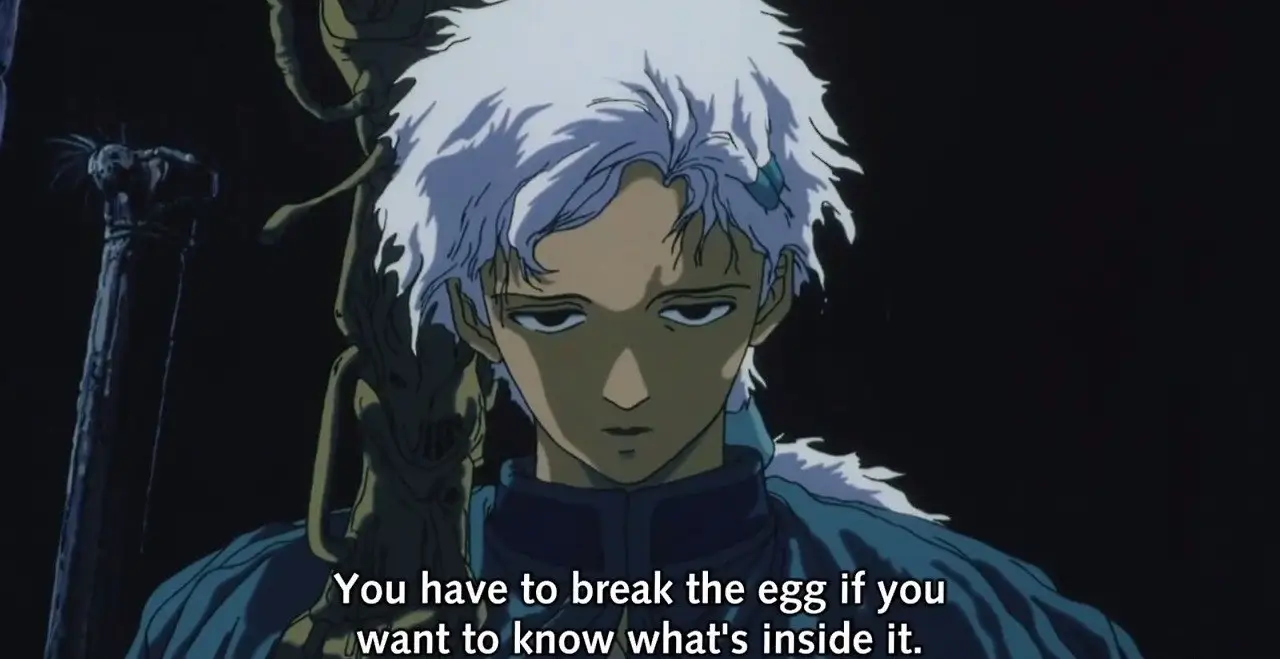
“The bird fights its way out of the egg. The egg is the world. Whoever will be born must destroy a world. The bird flies to God. The name of the god is Abraxas.”
"When I was in middle school, my classmate T. recommended to me a book by Hesse.
He said 'Inside this book is everything about me.' I didn’t know what he was on about.
However, that particular quote stuck with me. One day long afterwards, T. and I met up again after not seeing each other for over a decade, and I brought it up.
'What was that, again?'
He didn’t even remember the book existed, let alone that he’d recommended it to me. To think he’d just forget “everything about himself”… I wonder if Hesse wasn’t needed in the world T. lived in after middle school. In which case, I wonder why I didn’t forget. I experimentally added another passage to Hesse’s:
If we don’t crack the world’s shell, we will die without being born.
Smash the world’s shell. For the revolution of the world.
"
“These days, I rarely have them, but back in my early twenties, I often had dreams about high school. Dreams in which I was going to high school, not dreams about having gone. I’m talking about in the present tense, as a twenty something adult, putting on a uniform (the old kind with the clasp) and going to school. In the dreams, I knew clearly that I had graduated several years before, but I was pretending not to know and going anyway. Since it was a dream, this pretense was enough to fool my classmates. Not one of them ever noticed that I had no business being at school. Neither did the teachers. I sat in the corner of my class, in the dreams, thinking about how much I really shouldn’t be there.
The school in the dreams was not the Kanagawa Prefectural Noba High School that I had actually gone to. Rather, it was a school I had never seen. (For starters, Noba uniforms didn’t have a clasp; they were blazers.) Nevertheless, I knew all kinds of things about that school. To make a long story short, the setting for Boogiepop and Others, Shinyo Academy, is that school from my dreams, the only part of this novel that is fantasy. The rest is something different.
I think I failed miserably at being a teenage boy. I never once thought I was young, or had a future. (I often do now.) I never actively participated in class or anything else. I just sat there, wondering what I was doing there, and after I graduated, I wondered why I had spent so much time thinking about those sorts of things. I don’t particularly understand myself.
So, even now, I don’t really get the idea of going to school. I was twenty-eight when I wrote this novel, and over ten years have passed since I graduated. Even if I try to find the answer, I no longer have a school to go to, so the whole thing is permanently out of reach. It’s all too late now. It’s one of many, but this “what did I do in school?” question is a pretty big trauma for me. It’s like my first love that I never asked out. Augh! I was a dirty little angst-ridden idiot without a single thought for love. I imagine the reason behind the dreams is my conviction that I would be much better at being a high school student now.
Ultimately, school is a place where you have to be with others. That’s all. It ends without you ever really understanding much about each other, but even so, you bump into a lot of people and a lot of thoughts, and you still come back for more. Sadly, schools are not exactly set up to preserve that diversity. (Right, my readers in school?) I can’t help but think that’s a crying shame, but the entire world seems to work that way, and school isn’t that unique of a place in the world. That’s why, in my dreams, I’m always thinking, “God, I really hated that guy, but now I wish I’d known him a little better.” And I do all this while sitting there in the corner of the room.”
"As I wait for the miso soup to heat up, I sit in the kitchen doorway and gaze out at the thicket of trees in back. Then, suddenly, I have the feeling that long ago, and at some time in the future too, I sat, will sit, in the kitchen doorway like this, in exactly the same position, thinking exactly the same thing and looking at these trees. It’s as if the past, the present, and the future are all here in this one moment. This sort of thing happens to me once in a while. For example, I’m sitting in my room talking to someone. My eyes drift to a corner of the table and stop there. My mouth keeps moving, but meanwhile I’m having this weird illusion that at some time in the past I was in the same situation, talking about the same thing and looking at the same corner of the table, and that at some point in the future I’ll repeat the same experience again. Or I can be walking on some footpath far out in the country and be convinced that I’ve been there before. I’ll pass by a bean plant and pluck off one of its leaves, and, sure enough, I’ll feel that I’ve plucked this same leaf at this same spot sometime in the past and will pluck it again, time and again."
“It had always seemed to Emily, ever since she could remember, that she was very, very near to a world of wonderful beauty. Between it and herself hung only a thin curtain; she could never draw the curtain aside-- but sometimes, just for a moment, a wind fluttered it and then it was as if she caught a glimpse of the enchanting realm beyond-- only a glimpse-- and heard a note of unearthly music.”
“De pie en medio de la calle la poeta Alejandra Pizarnik guardó para sí un detalle con su mirada. Observó con cuidado las ventanas color lila de una casa de Fontenay-aux-Roses, un pequeño pueblo francés que, allá por los años sesenta, tenía un gran jardín de rosas en la estación de trenes. Un recorte de su estadía en ese país durante los años de juventud. Se lo confió a León Ostrov, su primer terapeuta, a través de una carta, luego de que él le contara de sus aventuras en París y de su decisión de llevarse algo de la ciudad, un souvenir. Pero Alejandra no compró una réplica miniatura de la Torre Eiffel ni acomodó la hoja de un árbol adentro de un libro. Eligió la casa de ventanas lila, su fachada. En palabras de Ostrov, 'de un lila tan mágico, tan como los sueños hermosos, que imaginaba que entraba en ella, y una voz la recibía: Hace tanto que te esperaba… Y allí se quedaba -para siempre- porque ya no tendría que buscar más'.”
“ 'What is REAL?' asked the Rabbit one day, when they were lying side by side near the nursery fender, before Nana came to tidy the room. 'Does it mean having things that buzz inside you and a stick-out handle?'
'Real isn't how you are made,' said the Skin Horse. 'It's a thing that happens to you. When a child loves you for a long, long time, not just to play with, but REALLY loves you, then you become Real'.
'Does it hurt?'' asked the Rabbit.
'Sometimes,'' said the Skin Horse, for he was always truthful. 'When you are Real you don't mind being hurt.'
'Does it happen all at once, like being wound up,'' he asked, 'or bit by bit?'
'It doesn't happen all at once,'' said the Skin Horse. 'You become. It takes a long time. That's why it doesn't happen often to people who break easily, or have sharp edges, or who have to be carefully kept. Generally, by the time you are Real, most of your hair has been loved off, and your eyes drop out and you get loose in the joints and very shabby. But these things don't matter at all, because once you are Real you can't be ugly, except to people who don't understand.'
”


“The flickering light made our shadows tremble.
As they trembled, Heavenly Demon's shadow overlapped with mine.
'If the sun represents life, then the shadow is pain.'
The lean shadow spoke.
'While each human's outline in life is separate, pain overlaps and multiplies. Thus, humans are not one through living but one through suffering.'
It was the doctrine of the shadow.
'If you say you wish to share pain with someone, it means you’re willing to spend a lifetime with that person. Thus, those who get hurt by everyone only wish to be with everyone. Child.'
A doctrine to be passed on by the only remaining mouth in this world.
'Gong-Ja.'
The mouth spoke to me.
'People not only decide who to hurt but can also choose who to be hurt by. The commoners you seek will not be pure. The group you save will not be noble. The one you love will not be perfect.'
The shadow whispered.
The whisper of the shadow carried the warmth of the candle.
'Yet, if you willingly accept pain from everyone, if you bear your bare skin to them, when they scratch you, it’s just them holding you too tightly, remember that.'
'Life is pain. But it is uniquely human pain. Baraya, Baraya, Agabaraya. Your heart is a burning flame. Burn it and see the shadows of others.'”
“A mycelial network is a map of a fungus' recent history and is a helpful reminder that all life-forms are in fact processes and not things. The 'you' of five years ago was made from different stuff than the 'you' of today. Nature is an event that never stops. As William Bateson, who coined the word genetics, observed, 'We commonly think of animals and plants as matter, but they are really systems through which matter is continually passing.'”
chirality (noun) - the phenomenon, in chemistry, physics and mathematics, in which objects are mirror images of each other, but are otherwise identical.
“No live organism can continue for long to exist sanely under conditions of absolute reality; even larks and katydids are supposed, by some, to dream.”
“Dreams shelter even the primitive minds of larks and katydids from those “conditions of absolute reality” that would drive any “live organism” insane. Hill House is “not sane,” as the narrator informs us, so presumably it is not only alive but existing under conditions of absolute reality—a strange assertion to make about a house, especially a haunted one. Although Eleanor’s experiences at Hill House will be both bizarre and fantastic, and she will eventually become deranged enough to deliberately drive her car into a tree, what she is headed toward is not delusion but a collision with this 'absolute reality.' Hill House will force her to acknowledge that she will never be free, that her dreams of leaving her corrosive past and her family behind are illusions, that wherever she goes she will only find the same hell she was running away from. Escape is a mirage. This is the real horror of Hill House.”
“Man, remember, until an hour before the Devil fell, God thought him beautiful in Heaven.”
“All children mythologise their birth. It is a universal trait. You want to know someone? Heart, mind and soul? Ask him to tell you about when he was born. What you get won’t be the truth: it will be a story. And nothing is more telling than a story.”
“For many years I claimed I could remember things seen at the time of my own birth. Whenever I said so, the grownups would laugh at first, but then, wondering if they were not being tricked, they would look distastefully at the pallid face of that unchildlike child. [...]
While they were still smiling from their laughter, the grownups would usually set about trying to confute me with some sort of scientific explanation. Trying to devise explanations that a child's mind could grasp, they would always start babbling with no little dramatic zeal, saying that a baby's eyes are not yet open at birth, or that even if his eyes are completely open, a newborn baby could not possibly see things clearly enough to remember them.
[...] No matter how they explained, no matter how they laughed me away, I could not but believe I remembered my own birth. Perhaps the basis for my memory was something I had heard from someone who had been present at the time, or perhaps it was only my own willful imagination. However that may have been, there was one thing I was convinced I had seen clearly, with my own eyes. That was the brim of the basin in which I received my first bath. It was a brand-new basin, its wooden surface planed to a fresh and silken smoothness; and when I looked from inside, a ray of light was striking one spot on its brim. The wood gleamed only in that one spot and seemed to be made of gold. Tongue-tips of water lapped up waveringly as though they would lick the spot, but never quite reached it. And, whether because of a reflection or because the ray of light streamed on into the basin as well, the water beneath that spot on the brim gleamed softly, and tiny shining waves seemed to be forever bumping their heads together there. . . .
The strongest disproof of this memory was the fact that I had been born, not in the daytime, but at nine in the evening: There could have been no streaming sunlight.
”
“My daddy said I was a different breed of dog from my brothers and sisters. ‘You know,’ Daddy said, ‘it’s some that can live their whole life out without asking about it and it’s others has to know why it is, and this boy is one of the latters. He’s going to be into everything!”
“Once, years ago, when we went to visit relatives in Kyushu, I got diarrhea from a tangerine I ate from the family altar. The room was laid in new, raw-smelling tatami mats, and when I bit into the tangerine segment my aunt had peeled for me the white sack resisted while the juice inside trickled down my throat, making me feel sick. Perhaps from sitting out as an offering on the altar for so long, it had lost all its sourness; with only sweetness remaining it seemed flat and dull, and I wondered why they bothered putting it on the altar only to eat it later. 'What’s the point of offerings, anyway?' I said. I don’t recall what my aunt said, and I think it was only after I started buying a cake for my oshi’s birthday that it made sense to me. I nibbled at my oshi’s face on the chocolate plaque nestled in the center of the whipped cream just like I was eating something that had already been placed on an altar. The meaning was in the buying and the sacrifice, and by the time I came to eat it, it was like a gift.”
mångata (Swedish, noun) - the roadlike reflection of moonlight on water.